They say that time is money. But if you understand the principle of compound interest, you will soon realise that time can quite literally become a money-making machine. It is no coincidence that Albert Einstein is said to have declared:
“Compound interest is the eighth wonder of the world. He who understands it, earns it. He who does not, pays it.”

Whether or not this quote really came from him, its underlying message remains just as relevant today. Compound interest is one of the most powerful – and often underestimated – tools in investing. It makes it possible to build passive income that multiplies itself over time.
In short, compound interest means you earn interest not only on your initial investment but also on the returns from previous periods. In other words, you earn returns on what you have already earned – and this “interest on interest” effect is what drives long-term investment growth.
With simple interest, for example, you would earn 7% per year on CZK 100,000 (that is, CZK 7,000 a year). With compound interest, however, the second year’s 7% return is calculated on CZK 107,000. In the third year, it is calculated on CZK 114,490 – and so on.
The result is exponential growth, often referred to as the “snowball effect”. The longer your investment horizon, the greater the final outcome.

Almost everyone has at some point encountered people discouraging them from a particular financial decision or, conversely, persuading them what to invest in. Compound interest is no exception – many people talk about it, but few truly understand how it works. If you are hesitating, it may be because of one of these long-debunked myths.
⏳ There is plenty of time to start investing
This common misconception may seem harmless at first glance, but in the context of compound interest it has a significant impact. Time is the key variable – the later you start investing, the more you limit your potential returns. Compound interest works best when it has enough time to “do its job”. Every additional year allows you to earn returns not only on your original investment but also on the gains from previous years. Delaying your decision could therefore cost you hundreds of thousands of Czech crowns. And if you prefer short-term investments, you will most likely also have to say goodbye to passive income.
Compound interest only works with large amounts
The advantage of compound interest is that its effect depends on the length of the investment period, not the size of the investment. Naturally, the exponential growth in returns is steeper with larger investments. If you are just getting started, there is no reason to wait until you have “saved up more”. Investing regularly, even with smaller amounts – for example, investing CZK 1,000 a month for 20 years – can generate very attractive returns thanks to compound interest.
Compound interest works the same way for all investment products
This is something to pay close attention to, as every investment product has a different interest structure. Not every platform offers a fixed annual return, so the rate of return may change over time. As we already know, compound interest works best over a long-term investment horizon, just like investing in general. In equity markets, annual returns are averaged over time, and compound interest also works with investments whose returns fluctuate.
It does not work if I do not see results immediately
One of the most common investing mistakes is expecting quick results. The basic rule of investing is not to panic. If you think you will see results within weeks or months, you are mistaken. You need to trust the process you have embarked on, which will ultimately bear fruit after years.
You can see how compound interest works in the chart below.
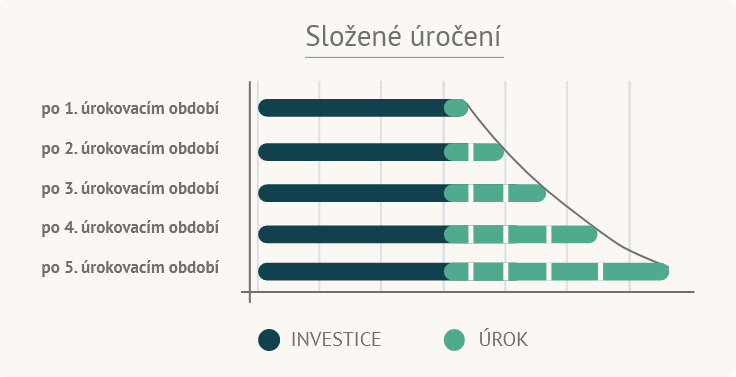
The chart clearly shows how compound interest works over time. With each interest period, not only does the value of the investment increase, but the gains themselves (the interest shown in green) also continue to earn interest. The result is progressively faster growth – this “interest on interest” effect is the foundation of exponential returns.
Not every investment platform offers an autoinvest feature – and neither does RONDA INVEST. However, that certainly does not mean you cannot benefit from compound interest with us.
How? The most effective approach is to reinvest the returns we pay out every month yourself. With a minimum investment of just CZK 1,000, you can easily reinvest even smaller monthly amounts.
For example, with an initial investment of CZK 200,000, you can reinvest your monthly returns, steadily increasing the total amount of invested capital. This approach allows you to build long-term passive income – exactly how compound interest works.
Another advantage of our platform is that you have multiple investment opportunities. You decide which projects to invest in. This gives you the flexibility to build your own portfolio according to your preferences and strategy, while also achieving effective diversification through regular investing.
In addition, using a secure investment with a fixed annual return makes it easier to calculate the effect of compound interest, giving you a clearer idea of the amount you can expect to have in the future.
20. 2. 2026
5 warning signs that an investment is not safe
 Premium
Yield

The return represents the amount of money you get for the capital invested. It indicates the difference between the final value of the investment and the capital employed.
p.a. means per annum, i.e. yield calculated on an annual basis.
Example:
You invest CZK 10,000 with a return of 10% p.a. We will pay you the income in a proportional amount every month, you will get a total of CZK 1,000 in income per year.
Maturity
The maturity date indicates the binding date by which the loan will be repaid and when your investment ends.
After this date, we will send the original invested amount to your account along with the last return.
Min. investment
The minimum investment indicates the lowest possible amount that can be invested in the project.
LTV
LTV = Loan to Value
(translated as “loan to value”)
LTV indicates the ratio of the property’s value to the loan’s value. The lower the LTV, the higher the collateral.
LTV calculation = loan amount / estimated market price × 100

Svitávka (Blansko District)

Yield
The return represents the amount of money you get for the capital invested. It indicates the difference between the final value of the investment and the capital employed.
p.a. means per annum, i.e. yield calculated on an annual basis.
Example:
You invest CZK 10,000 with a return of 10% p.a. We will pay you the income in a proportional amount every month, you will get a total of CZK 1,000 in income per year.
Maturity
The maturity date indicates the binding date by which the loan will be repaid and when your investment ends.
After this date, we will send the original invested amount to your account along with the last return.
Min. investment
The minimum investment indicates the lowest possible amount that can be invested in the project.
LTV
LTV = Loan to Value
(translated as “loan to value”)
LTV indicates the ratio of the property’s value to the loan’s value. The lower the LTV, the higher the collateral.
LTV calculation = loan amount / estimated market price × 100
Štěnovice (south of Plzeň)

 Special Offer
Yield
The return represents the amount of money you get for the capital invested. It indicates the difference between the final value of the investment and the capital employed.
p.a. means per annum, i.e. yield calculated on an annual basis.
Example:
You invest CZK 10,000 with a return of 10% p.a. We will pay you the income in a proportional amount every month, you will get a total of CZK 1,000 in income per year.
Maturity
The maturity date indicates the binding date by which the loan will be repaid and when your investment ends.
After this date, we will send the original invested amount to your account along with the last return.
Min. investment
The minimum investment indicates the lowest possible amount that can be invested in the project.
LTV
LTV = Loan to Value
(translated as “loan to value”)
LTV indicates the ratio of the property’s value to the loan’s value. The lower the LTV, the higher the collateral.
LTV calculation = loan amount / estimated market price × 100
Steti near Litomerice
 CALCULATOR

The calculator calculation is based on a model example of a one-time repayment loan investment (full principal repayment at the end of the loan term). Returns are paid to investors monthly, and the calculator does not consider reinvestment. The actual performance of the investment may differ from the model example. It represents gross yield, subject to taxation. At RONDA INVEST, there are no entry fees or regular fees.